

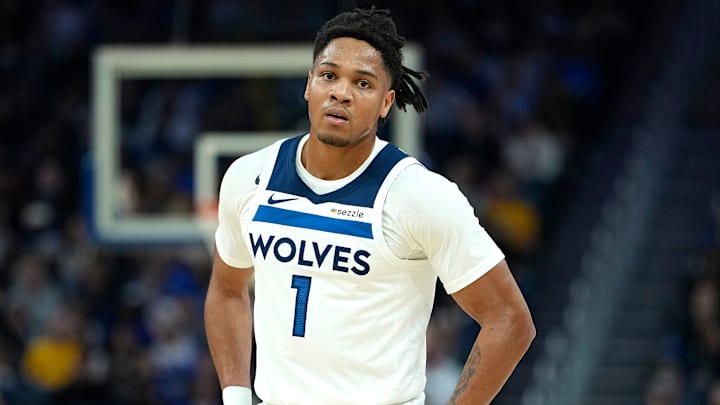
A lot stood out to me during the Minnesota Timberwolves' Christmas night 142-138 overtime loss to the Denver Nuggets. Objectively, a 44-point performance with an insane 3-pointer to force OT from Anthony Edwards and a 56-point triple-double from Nikola Jokic make this game pretty unforgettable. However, one thing that might get lost that shouldn't is the Timberwolves' wonky rotations.
Most notably, Terrence Shannon Jr. played 10 minutes while Jaylen Clark played five minutes. Okay, I understand this might not seem significant, but it absolutely was, and Chris Finch's continued faith in Shannon, yet unwillingness to fully unleash Clark all season long, has been puzzling. This was a season low of 5:21 minutes for Clark, and it couldn't have come at a worse time.
Yes, Clark is getting 1.3 minutes per game more than Shannon. Nevertheless, with how they're both playing, the difference should be more. In the context of the Nuggets game, Finch's decision to turn to Shannon over Clark was illogical.
Clark needs to play over Shannon
Listen, I understand, not wanting to cut bait with last year's first-round pick (although it looks like Finch has already done so with Rob Dillingham), but there's a time and a place. I'm fine with Shannon playing against the Nuggets, and I won't give up on him becoming a productive player.
However, Finch shouldn't have put him in for a second shift after he struggled in his first one, especially since the Wolves needed defense, not offense, in a big-time game.
The Wolves had an abysmal 157.4 defensive rating without Gobert on Thursday. So why in the world would you put your team's worst statistical defender in over the defensive specialist Clark when Gobert sat? The Timberwolves' defense is 17.5 points per possession worse with Shannon on the court, which is the worst mark in the NBA. Yet with Clark, they're 2.8 points better.
Clark is a stifling on-ball defender with great defensive playmaking instincts. Whereas Shannon often gets blown by and struggles with off-ball positioning.
Despite Shannon's offensive reputation, he is averaging just 0.3 points more than Clark on a worse effective field goal percentage. Shannon's 40.5 percent 3-point shooting has been his saving grace this season and gives him one advantage over Clark. Regardless, my point is you aren't giving that much offense with Clark on the court.
Shannon left Thursday's game with a foot injury, which has been bothering him throughout the season. Perhaps this explains some of his season-long struggles. Maybe he re-aggravated it during the game, but if Finch knew about it beforehand, that's all the more reason to play Clark. Hopefully, this isn't a long-term injury for Shannon.
While this game is a prime example of Finch's unwavering belief in Shannon and lack of belief in Clark, it's been a season-long problem. If Shannon is struggling offensively, Finch will often continue to ride with him despite the defensive struggles, but he typically won't do the same with Clark despite his elite defense.
The Timberwolves are 14-0 when Clark plays 14 or more minutes and just 5-9 when he plays fewer than 14 minutes. I'll continue to write this in every article related to Clark, as it's clear his defense impacts winning at a high rate. Yet Clark doesn't reach this threshold often in favor of more minutes, Shannon, who, by nearly every measure, has been worse than Clark.
At 20-11, the Wolves are overall in a good spot. To reach their ceiling, however, they need more Clark and less Shannon on nights where his offense isn't there.
 Add us as a preferred source on Google