

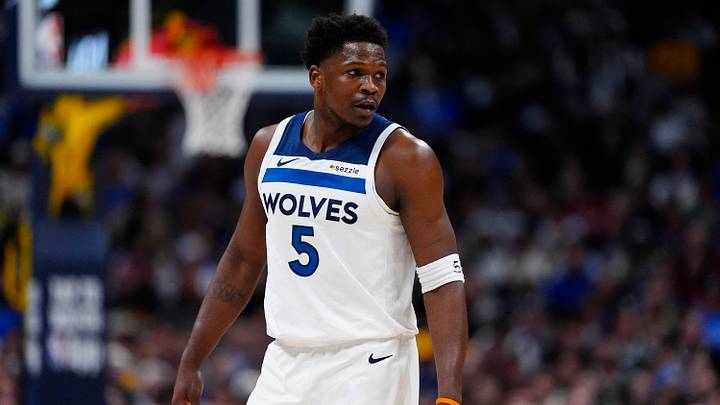
While Anthony Edwards is eligible for a contract extension, it's long been assumed that he and the Minnesota Timberwolves will wait until next offseason when he's (possibly) eligible for a four-year $301 million supermax extension.
However, since he played in 61 games (slightly missing the 65 games played mark for awards), Edwards isn't automatically eligible for a supermax extension in 2027.
Edwards has to make an All-NBA team this upcoming season to become eligible for a supermax; otherwise, he'll have to wait until 2028 (a year before his contract is up), and even then he won't be able to earn a full five-year supermax. The great Bobby Marks of ESPN recently broke this down during an early preview of the 2027 offseason.
"Edwards' 28.8 points per game last season trailed only Luka Doncic and Shai Gilgeous-Alexander, but the Timberwolves' superstar was ineligible for All-NBA because he fell short of the 65-games-played threshold. If Edwards had played four more games, he would have been eligible to sign a four-year, $301 million supermax extension next summer. Similar to Maxey, Edwards will need All-NBA, MVP or Defensive Player of the Year honors in 2026-27 to become eligible for that deal. Edwards will not be eligible to sign the five-year supermax extension in the 2028 offseason even if he is named All-NBA in 2026-27," Marks wrote.
As long as he can appear in 65 games, Edwards is a shoo-in for an All-NBA team. He made All-NBA Second Team in 2023-24 and 2024-25. Had he played four more games last season, he would have likely made another All-NBA second team. Entering is age 25 season with LaMelo Ball in the mix, Edwards is primed to continue improving, which could lead to an All-NBA First Team jump.
The problem is that he could feasibly have a healthy season where he plays in 60 or so games and performs at an All-NBA level, and still won't be eligible for a supermax next summer. Ensuring a 65-game minimum for awards and having awards determine contract eligibility is a flawed process at the end of the day.
Anthony Edwards is proof that contract eligibility shouldn't be based on awards
Look, you need some way to determine who's eligible for what contract, and even if Edwards doesn't earn a supermax, he'll earn a hefty payday. Furthermore, within all likelihood, Ant will play 65-plus games (as he did every year before last season) and sign a supermax. Worst case, he'll likely sign a supermax extension in 2028.
However, the possibility of a player missing out on supermax money (which is significantly more than the standard max) just because he wasn't award-eligible, even if he barely missed the games played threshold in back-to-back years, is silly.
Even if Edwards doesn't make an All-NBA team this upcoming season, the Timberwolves would be eager to give him a supermax next summer. He is already a top-five-level player, and he changed the course of the franchise.
It would be a big investment, but nobody would argue that he isn't a supermax-worthy player. If the Wolves (and everyone else) believe Ant is a supermax-level player, NBA awards shouldn't prevent them from signing him to such a deal.
Frankly, few players are truly supermax-caliber, but Edwards is one who universally is, but there's a chance the NBA's criteria for eligibility foils this chance. Simply put, the Wolves (and everyone else) believe Ant is a supermax-level player; NBA awards shouldn't prevent them from signing him to such a deal.
Hypothetically, there's a world where Edwards plays in fewer than 65 games and misses out on supermax eligibility, but Jaden McDaniels either wins DPOY or makes an All-NBA team and is supermax eligible. To be clear, this is far from likely, but this highlights why awards determining contracts is a flawed rule.
Jalen Johnson, Zion Williamson, and Tyrese Maxey are three other players Marks noted to watch for supermax eligibility. With all due respect, the possibility that one of those could be supermax eligible next summer, but Ant might not be, is laughable.
As noted, this is unlikely to be a major issue for Edwards (and frankly, if he signs for below the supermax, that would be great for the Timberwolves). Still, having contract values tied to awards is inherently a flawed system, and Edwards not being automatically supermax eligible next summer highlights this issue.
 Add us as a preferred source on Google