

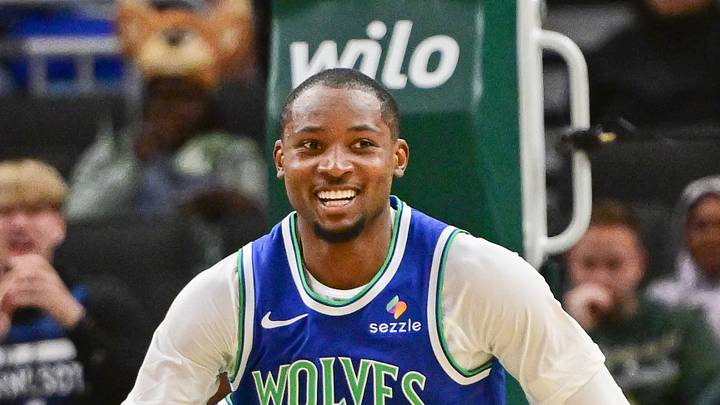
It's no secret that the Julius Randle-Minnesota Timberwolves era didn't go as planned. Randle ran himself out of town with a dreadful 2026 playoff run. There's no denying his shot selection is frustrating to watch and, more importantly, a major flaw.
Jonathan Kuminga has some clear similarities with Randle. Both players are physically imposing forwards who love to create for themselves, often settle for ill-advised shots, struggle to make quick decisions, and are poor 3-point shooters. Moreover, despite having physical gifts, both players are also prone to off-ball lapses on defense.
Hearing this is the last thing many Wolves fans want to hear right now. But I'm here to tell you this isn't necessarily a bad thing. Yes, Randle was a flawed second option, one that the Wolves couldn't win at the highest level with. After the playoffs, I think everyone can agree with that.
Having a player with a similar skill set to Randle as your fourth option, though? That's more than okay. In fact, if Kuminga buys into being a complementary player (which should be the case given his contract structure), his skill set will uplift the Wolves on both ends of the floor.
Jonathan Kuminga can thrive as a scaled-down Julius Randle
Some Wolves fans might not like to hear this, but Randle is ultimately still a very useful player.
He can punish mismatches due to his strength and is a force to deal with around the rim. Randle is also a stout on-ball defender against forwards despite his engagement issues off the ball. Plus, he offers some value as a tertiary or even secondary playmaker despite his frustrating tendency to over-dribble.
Again, Randle is not an ideal second option, particularly alongside Anthony Edwards. Regardless, parts of his skill set in a scaled-down role would be highly valuable, and that's what the Wolves are getting with Kuminga.
Outside of playmaking juice, Kuminga can offer similar value to Randle as a mismatch beater, interior scorer, and physical defender. Interestingly, Randle (85th percentile) and Kuminga (81st percentile) had similar rim-attempt frequency per 100 75 possessions according to Databallr.
Both players have ball-stopping tendencies; there's no denying it. A methodical isolation scorer with poor shot selection as your second option can derail an offense. If a player like this is in a complementary role, though, you can cover up this flaw. Play-finisher is the word I use to describe Kuminga's offensive role. He won't be initiating plays. Rather, he'll be attacking advantages and mismatches created by others. LaMelo Ball's playmaking should help with that.
Will Kuminga still have some moments of shaky shot selection at times? Sure, but if Kuminga buys into his role, he won't have sizable creation duties, and in turn, his flaws will be less visible. And if the Wolves ever need a shot in the arm, or are playing short-handed, we could see Kuminga's creation be used in spurts. Kuminga creating for himself shouldn't be a focal point of an offense, but as an occasional wrinkle it could be fine.
Kuminga is also a much better cutter and lob threat than Randle, which gives the Timberwolves another way to utilize his play-finishing skills. Furthermore, Kuminga is a better athlete, which benefits him in transition and when crashing the glass.
All in all, if Kuminga fully embraces a complementary role, he'll provide the Timberwolves with a ton of all-around value despite his flaws.
 Add us as a preferred source on Google